
This quarter, a request for proposal reached us from a real estate developer. A page list. A 3D walkthrough for the new project. Three reference websites, two of them from competitors. A launch date before Diwali.
Agencies would be scored on three things: portfolio, timeline and cost.
I read it twice, looking for the things that decide whether a website pays for itself. They were not there.
Which pages bring enquiries today, and what happens to them when the old site is switched off? Who writes the content, and when? Where does an enquiry go after someone presses submit, and how fast does sales call back? How will anyone know, 90 days after launch, whether the money was well spent? Who looks after the site once the agency leaves?
None of these is a design question. Together, they decide whether the site earns back what it costs. Not one of them carried a single mark on the scoring sheet.
I do not blame the team that wrote it. For years, we answered briefs like it exactly as written. We designed what was asked, launched on time and moved on. Some of those sites looked excellent.
Not all of them paid for themselves.
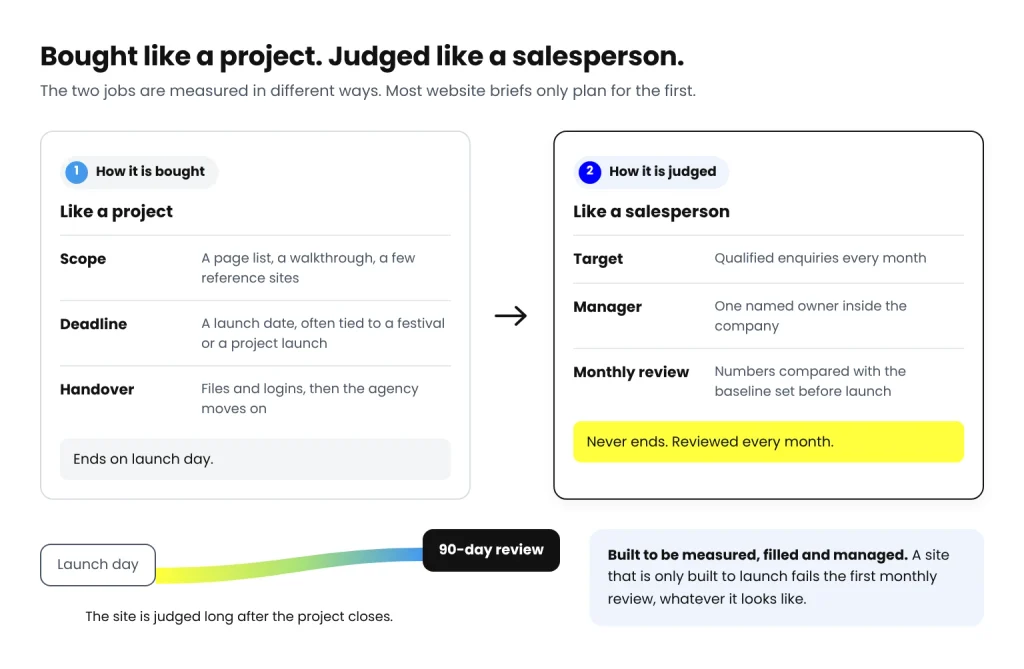
Most companies buy a website like a project, then expect it to perform like a salesperson.
A project has a scope, a deadline and a handover. A salesperson has a target, a manager and a monthly review. When a website is bought like the first and judged like the second, it fails the review. Not because it looks wrong, but because nobody built it to be measured, filled with the right content or managed after launch.
That is why a website redesign is not a design project. The look matters. It is simply the last problem to solve, not the first.
Why the look gets the blame
Redesigns usually begin with a feeling, not a finding.
Sometimes the founder is tired of the site. Jakob Nielsen explained why years ago: insiders spend far more hours looking at their own website than any customer does, so they tire of it first. His advice still holds: “Users hate change, so it’s usually best to stay with a familiar design and evolve it gradually.”
Sometimes a competitor relaunches, and the company’s own site suddenly “looks old”. Sometimes the sales team complains about lead quality, and the website is the easiest thing to change. And sometimes the copy says nothing a buyer can use, and a new layout is expected to fix the words.
In every case, the look takes the blame because it is the only part everyone in the boardroom can see. Content, structure and the path an enquiry takes are invisible in a design review. So they never make it into the brief.
This is not an argument against redesigns. Nielsen Norman Group lists clear cases for a full rebuild, such as outdated technology or a structure that has become a tangled mess. Even then, the look is only one part of the job.
What the brief never asks
Start with a baseline. How many enquiries does the current site bring in a month? How many of those does sales mark as qualified? Which pages do they come from? If nobody writes this down before the redesign, nobody can prove anything after it. The new site will be judged on opinion, and opinions in a boardroom rarely agree.
Then ask the people who speak to buyers every day. What do buyers ask on the first call? What makes them go quiet? What do they find on a property portal, a competitor’s site or YouTube that they could not find on yours? An agency cannot get these answers from outside. A founder can get them in one meeting.
Finally, look at how the proposals will be scored. When agencies compete on portfolio, timeline and cost, the first things cut to win on price are the ones nobody can see in a proposal: discovery, content, redirects and support after launch. The brief ends up buying pages, not results.
What the build gets wrong
Content arrives last
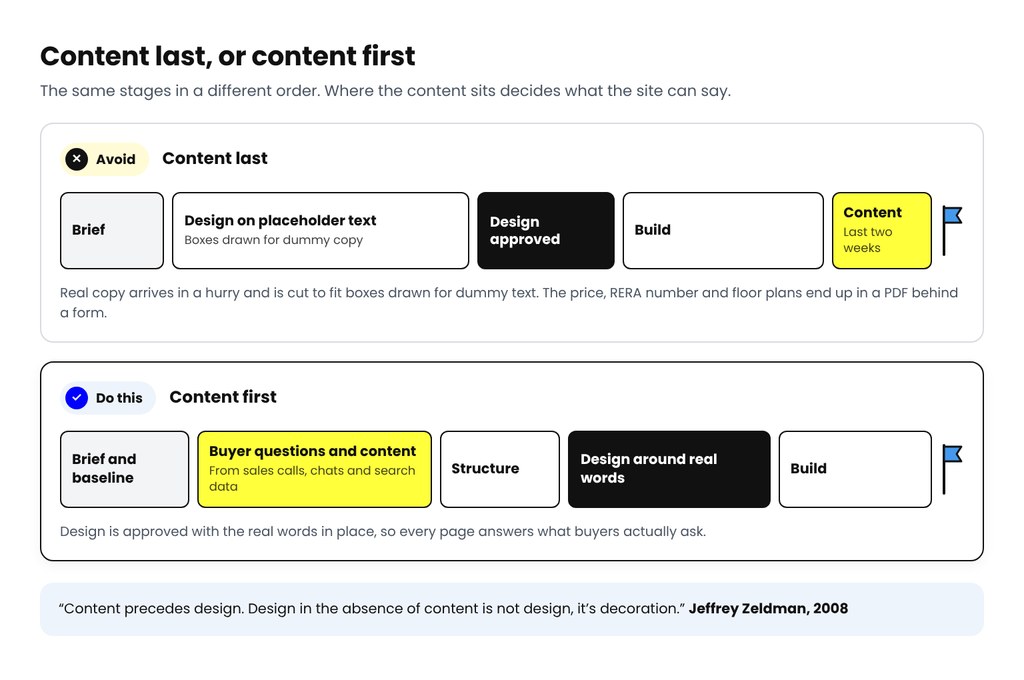
In most projects, the design is approved with placeholder text, and “content to be provided by client” sits quietly in the proposal. The real copy arrives in the last two weeks, written in a hurry and cut to fit boxes drawn for dummy text.
Jeffrey Zeldman put it best in 2008: “Content precedes design. Design in the absence of content is not design, it’s decoration.”
The cost shows up in what buyers cannot find. On many real estate websites, the facts a buyer needs. sit inside a PDF brochure behind a form: the price range, the RERA registration number, the possession date and the floor plans. A buyer has to hand over a phone number to see them. Search engines cannot reach them at all.
Content is also why most pages are never found. Ahrefs found that 96.55% of pages get no traffic from Google, mainly because nobody searches for the topic, no other site links to the page, or the page does not match what the searcher wanted. None of those reasons is about design.
A new website starts close to zero, however good it looks. When Vijay Transmission’s new website, which we built, went live in June 2025, it had 2 visits from search that month. What moved the number was content: a proper page for every product line, and a blog answering the questions buyers in Africa and the Gulf ask. By May 2026, search was bringing close to 600 visits a month. Between March and August, blog posts brought in more of those visits than all the product pages combined. Not everything has moved yet. The earthing rod pages are still outside Google’s top 100.
Built for the boardroom screen
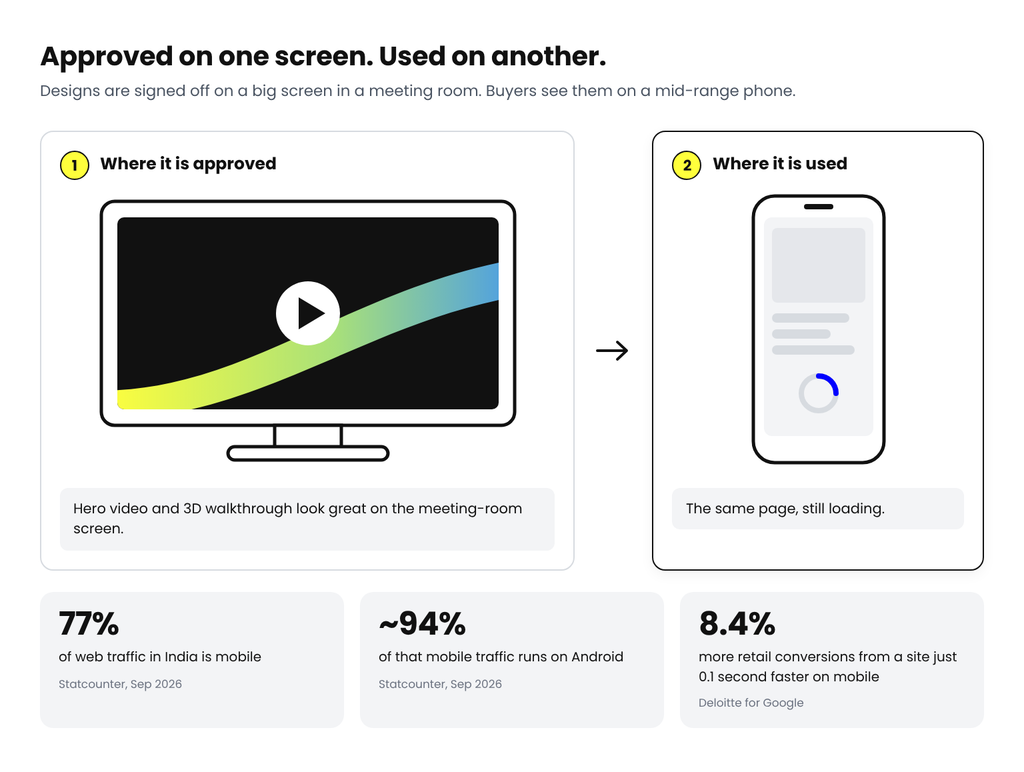
Designs are approved on a large screen in a meeting room. They are used on a phone. In India, 77% of web traffic is mobile, and nearly 94% of that runs on Android. The hero video and 3D walkthrough that win the approval meeting are often the same things that slow the page on a buyer’s phone.
Speed is not cosmetic. In a Google-commissioned Deloitte study, a 0.1-second improvement in mobile speed lifted retail conversions by 8.4%.
Many buyers also never see the homepage. They land on a project page from an ad or a link shared on WhatsApp, yet the homepage gets most of the design time. When we built new websites for two branches of a school network for the 2024-25 admissions season, we designed them around one job: helping parents find what they needed and reach the school quickly. With Google and social campaigns behind them, the sites brought in over 1,000 admission leads at a cost of ₹300-plus per lead.
Your website now has a second reader
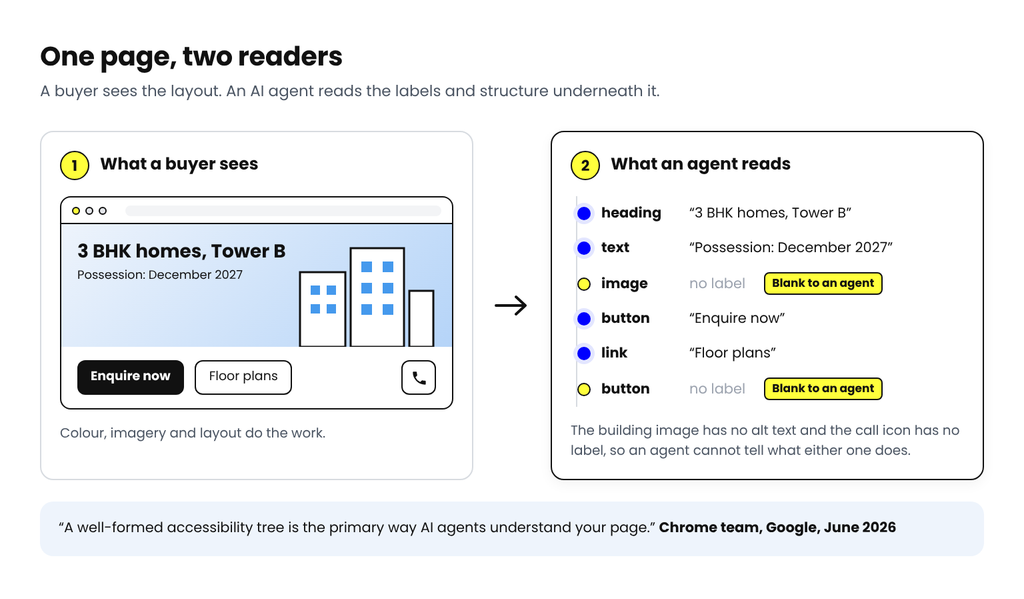
There is one reader no brief lists. Before a buyer visits your site, software has often read it for them.
Ahrefs found that when Google shows an AI Overview, the top-ranking page now gets a 58% lower click-through rate on average. Google opened AI Mode to users in India in July 2025, its second full rollout after the US. In business buying, 6sense’s 2025 study of around 4,000 buyers found that 94% use chat tools such as ChatGPT while buying, and that buyers first contact a vendor 61% of the way through their journey.
Our own client data points the same way, in small numbers. Between June and September this year, visits from AI assistants such as ChatGPT and Gemini made up under 0.4% of sessions on three client websites. Those visitors converted 3.4 to 6.9 times better than the average visitor, likely because they arrive having already asked a specific question.
The next reader will not just read. It will act. In June 2026, Google’s Chrome team announced an Agentic Browsing check in Lighthouse, its free site-testing tool, to show how well automated agents can use a page. Its explanation is plain: “A well-formed accessibility tree is the primary way AI agents understand your page.” In simple terms, agents read labels, headings and page structure. Your colour palette barely registers.
So the parts a design review ignores are exactly the parts these new readers depend on.
What Google itself says
Google has been direct about this. Its guide to generative AI features in Search says that “optimizing for generative AI search is optimizing for the search experience, and thus still SEO”. In plain terms, it is still search engine optimisation.
The guide separates “commodity content”, using the example “7 Tips for First-Time Homebuyers”, from content that “provides unique expert or experienced takes that go beyond common knowledge and the ordinary.” It asks for pages “organized by paragraphs and sections, along with headings that provide a clear structure to navigate content,” and for sites that display well on every device with less delay.
It is equally clear about what is not needed: “You don’t need to create new machine readable files, AI text files, markup, or Markdown to appear in Google Search.”
Read together, Google is describing a content and structure job. Nothing in it rewards a new colour scheme.
What launch day breaks
Launch day is where a redesign can quietly undo years of work.
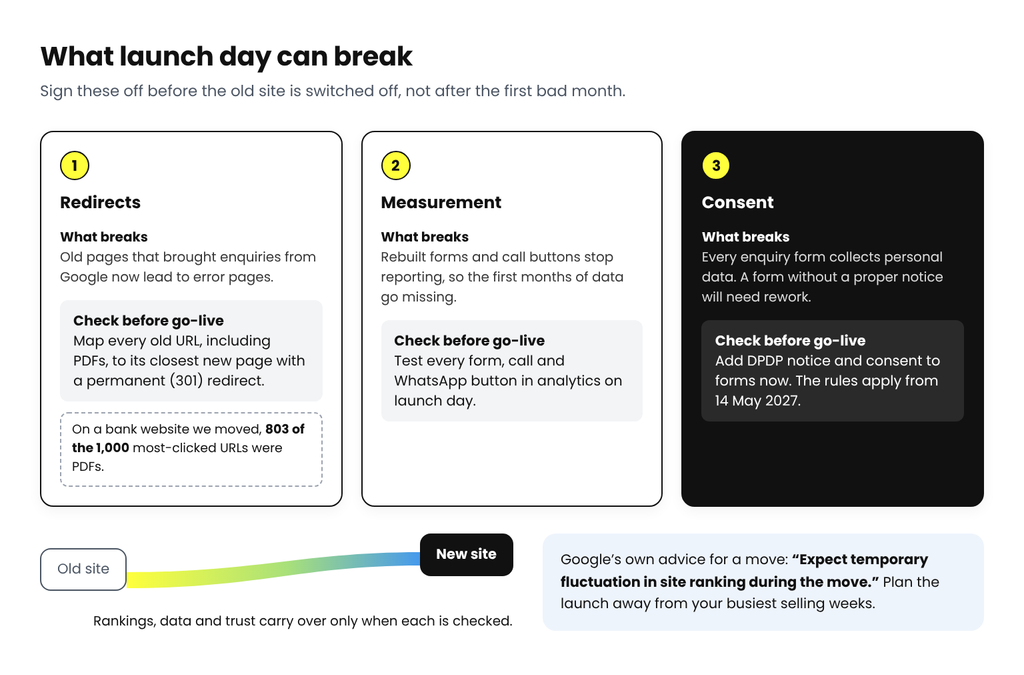
When pages move to new web addresses, Google’s site move guidance is clear: “It’s important to map your old site’s URLs to the URLs for the new site,” using permanent redirects, often called 301s. Skip that map, and the pages that used to bring enquiries from Google now lead to error pages. Even when the move is done well, Google warns: “Expect temporary fluctuation in site ranking during the move.”
We ran SEO for M3M India through its website relaunch in February 2025. Every address changed, from pages like /about-us.php to /our-story. In the first week, visits from Google fell from about 3,400 a week to 2,764, the fluctuation Google warns about. With every old address redirected to its new page, the dip was short. From April to September, with SEO work continuing on the new pages, visits from Google were 45% higher than in the same months of 2024.
The map has to cover more than pages. When the RBI asked every bank to move its website to a .bank.in address, we moved Capital Small Finance Bank to capital.bank.in in September 2025. In the nine months after the move, 803 of the 1,000 most-clicked addresses in Google were PDFs: application forms, rate sheets and the like. A page list does not show these, so the map was built from a full crawl, the sitemaps and Search Console data. Our website migration guide covers that process step by step.
Launch day also breaks measurement. Forms and call buttons are rebuilt, the tracking on the old ones does not always come across, and the first months of data, when everyone is judging the new site, go missing. It happened on the M3M relaunch too. Enquiry tracking went live in June, four months after launch, so until then the reports showed visits but not leads. Once it was in place, they showed 1,782 people from Google search sending an enquiry between June and September.
Another problem is on its way. India’s Digital Personal Data Protection Rules were notified on 14 November 2025, and the notice and consent requirements apply from 14 May 2027. Every enquiry form collects personal data. A site launched this year without proper consent notices is a site that will need rework next year.
What happens after someone presses submit
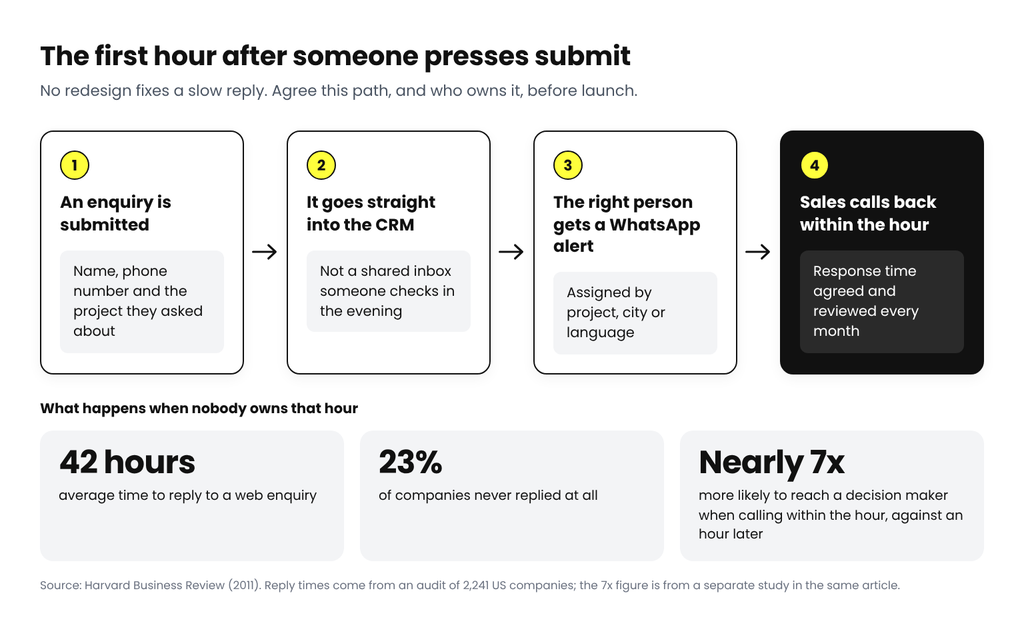
No website brief I have read covers the minutes after an enquiry lands. It is now the first place I look.
In a Harvard Business Review audit of 2,241 US companies, the average response to a web enquiry took 42 hours, and 23% never responded at all. A separate study in the same article found that firms that tried to call back within an hour were nearly seven times as likely to reach a decision maker for a real conversation as those that tried even an hour later. The data is from 2011 and from the US, but I have not seen Indian sales teams do much better.
If enquiries land in a shared inbox that someone checks in the evening, no redesign will fix the result. Route them into the CRM, the system your sales team tracks leads in. Alert the right person on WhatsApp. Agree a response time before launch, not after.
The same thinking applies to the months after launch. Most budgets end on go-live day. Nobody owns the site, the content system is too complicated for the in-house team, and soon the prices, inventory and possession dates are out of date. Improving a site in steady steps only works if someone is responsible for taking them.
How we start a redesign now
This is where our own process has changed most, and where AI earns its place. It does the groundwork. People make the calls.
Before we quote, we use only what is public. We put the questions a buyer would ask into ChatGPT, Gemini, Perplexity and Google’s AI Mode to see whether the brand appears and what is said about it. We crawl the public pages and test the site on a mid-range Android phone over mobile data.
Once we are appointed, and with the client’s consent, we go inside. We use Claude or ChatGPT to group anonymised enquiry emails, WhatsApp chats and call notes into the questions buyers keep asking and the site never answers. Then we check every page against what people actually searched for, using the client’s Google Search Console data, and flag vague claims, duplicate pages and missing proof.
It has limits. The engines give different answers from week to week, so we look for patterns, not a single screenshot. Grouping chats misses tone and urgency, so someone on our team still reads a sample of the real conversations. And no audit can decide what a company should stand for. That is still a conversation between people.
Before you sign off
If you are about to approve a redesign, add these to the brief before it goes out:
- Today’s numbers: enquiries a month, the share sales marks as qualified, and the pages they come from. Review the same numbers 90 days after go-live.
- The questions buyers ask your sales team most often, and where the new site will answer each one.
- Every page that brings traffic or enquiries today, and where each one will redirect.
- Who writes the content, and by when, before the design is signed off.
- What happens to an enquiry in the first hour, and who is responsible for it.
- Who owns the site after launch, with a budget for the first 90 days.
If a proposal comes back without asking about any of these, ask why.
Then spend the rest of the budget on the look. It matters. A clear, confident design earns trust in the first few seconds and makes everything underneath easier to use. It just works best as the last layer, not the first.
That is what we mean by Performance, Simplified. Fewer things, done in the right order, each one measured.
Frequently asked questions
Start with the numbers and the questions buyers ask, not the look. If the technology is outdated, the structure is a tangle or the site is hard to update, a rebuild may be right. If the problems are thin content, broken redirects or slow follow-up, fix those first, because a new design will not.
It can, if pages change address without permanent redirects. Google advises mapping every old URL to a new one and warns that rankings can fluctuate during a move, which can take a few weeks or more to settle for a medium-sized site. Planned properly, the risk is much smaller.
Not for Google. Its guide says you don’t need new machine-readable files, AI text files or special markup to appear in Search. Clear structure, readable text and useful content matter more.
Measure what the site was hired to do: qualified enquiries, the pages they come from and how fast sales responds. Record the same numbers before launch so you have something to compare against. Traffic and time on site are useful signals, but they are not the result.
One named person inside the company, with a small budget and a monthly review. An agency can do the work, but someone inside has to decide what changes and why. Without an owner, prices, offers and content go out of date quickly.
Yes. First impressions count, and a clean design makes good content easier to use. The point is the order: fix what the site says and how it works, then make it look right.